The Normandy D-Day Beaches: A Complete Visitor Guide
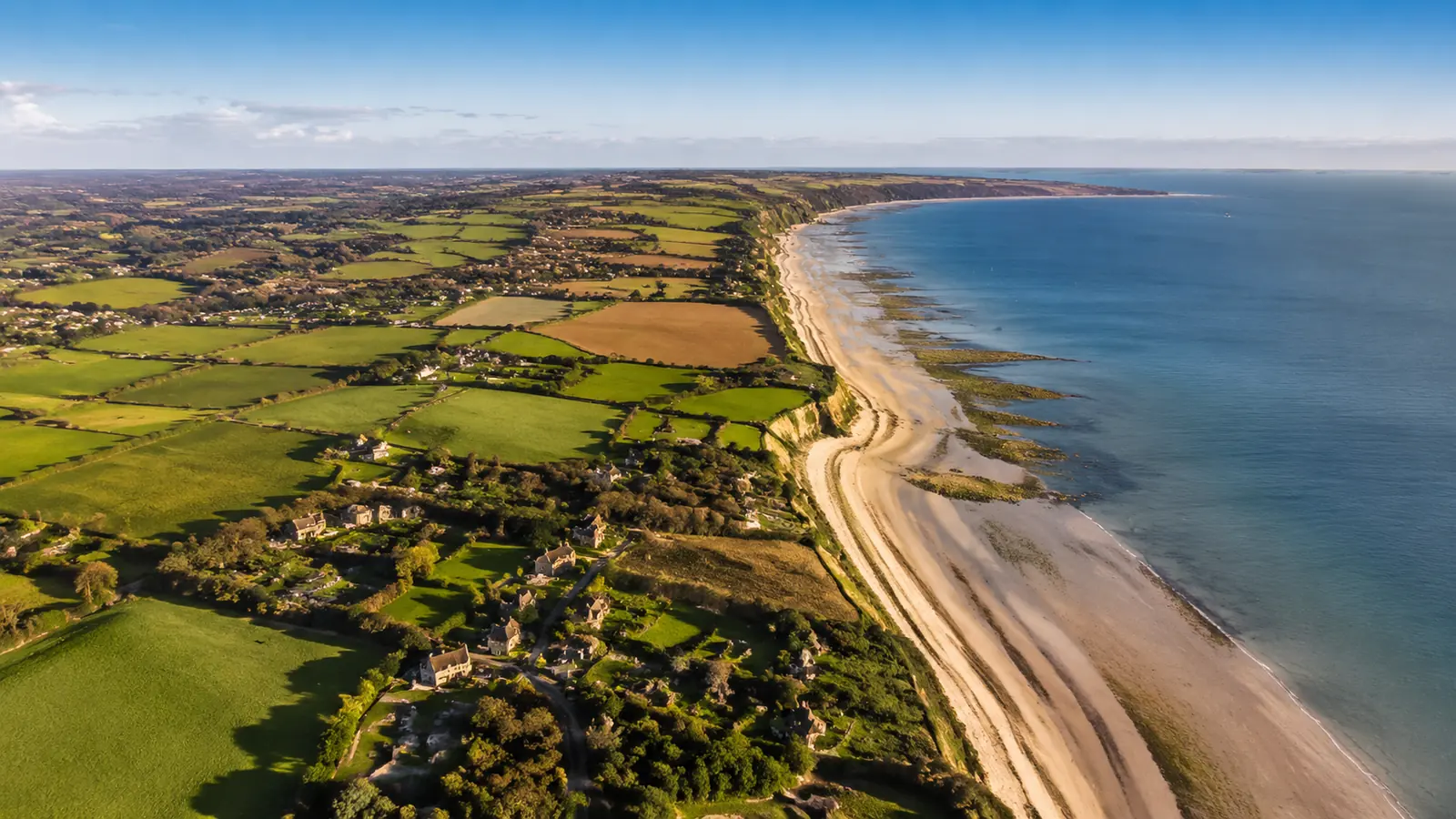
The five D-Day landing beaches run for roughly 80 km of Norman coast between Sainte-Marie-du-Mont and Ouistreham. There is no railway along them and almost no bus service between them, which is why most visitors see them either on a guided day from Bayeux or on a long day trip from Paris. This is the whole picture: the two sectors, what survives at each beach, and how to put a day together that works.
I grew up in Bayeux and spent four seasons working front of house at the Musée du Débarquement in Arromanches. The conversation I had most often there started the same way: someone had taken the morning train from Paris, walked out of the station, and only then discovered that the beaches were still a car ride away. Nobody had told them. That is what this site exists to fix.
The geography is the problem, not the history
The five landing beaches are strung along roughly 80 km of coast. There is no railway running beside them and never has been. The sites people actually come for — Omaha, the American Cemetery, Pointe du Hoc, Utah, Sainte-Mère-Église — sit between 15 and 60 km apart with almost nothing useful running between them. The NOMAD bus from Bayeux to Colleville-sur-Mer makes one round trip a day, and only from 20 April to 5 November. Line 101 from Caen to Courseulles-sur-Mer is better, eight round trips on a weekday, but it lands you in the eastern sector, which is not where the default tour goes. So the first question is never which tour looks nicest. It is whether you have a car, and if you do not, a guided day stops being an indulgence and becomes the transport — which is why the car-free version of this trip is the page I rewrite most often.

Two sectors, and why your tour is American
The dividing line is roughly Port-en-Bessin, a working fishing port. West of it is the American sector: Utah, Omaha and Pointe du Hoc between them. East of it is the British and Canadian sector: Gold, Juno and Sword. H-Hour was 06:30 on the two American beaches; the British and Canadian landings came later, roughly 07:00 to 07:45, because the tide runs east to west along this coast. Almost every day tour sold as a “Normandy D-Day tour” is the American itinerary, and nobody says so before you book. If your grandfather came ashore at Juno with the 3rd Canadian Division, or at Gold with the 50th Northumbrian, the standard minivan will drive you the other way for eight hours. Check which sector you actually want before you pick a date.
What is still there
Not the same amount at each beach, which surprises people. At Utah the museum is built onto a German bunker at La Madeleine, in Sainte-Marie-du-Mont. Omaha is eight kilometres of wide, flat, open sand under the bluffs; at low tide the sea goes out for what feels like a kilometre, which tells you more about 6 June than any display case. The American Cemetery stands on the bluff above it with 9,389 graves and 1,557 names on the Walls of the Missing. Pointe du Hoc is the most intact bombed landscape on the coast, all craters and casemates, though the observation bunker platforms are closed at present and you keep to the marked paths. At Gold the Mulberry harbour caissons are still lying off Arromanches: about 96 Phoenix units, of which only 11 remain well preserved and 67 are ruins, with chloride corrosion projected to leave none in good condition by 2075. A genuine reason not to keep putting the trip off. Juno has the Juno Beach Centre at Courseulles-sur-Mer, which asks an hour and a half plus a guided bunker walk. Sword has the Grand Bunker at Ouistreham and, inland, Pegasus Bridge, where the original 1944 span is preserved in the museum grounds a few yards from the replica now carrying traffic. The Café Gondrée opposite was the first house in France to be liberated. I have set out which of these are worth your morning and which are not.
Why I give you ranges instead of numbers
You will see confident single figures everywhere for D-Day, and most of them are one source quoted without its caveat. Troops landed on 6 June is given as over 132,000 or as nearly 160,000 depending on whether the 23,400 airborne are counted with the seaborne. Casualties at Omaha are put at about 2,400 by the National WWII Museum, at 3,600 with around 770 killed by the Commonwealth War Graves Commission, and at 2,000 to more than 5,000 in other accounts. Sword is quoted at 683 by one source and about 1,300 by another, which is a total being confused with a figure for the dead. The National WWII Museum puts it plainly in its own fact sheet: “many of the numbers associated with D-Day assault forces and their casualties are approximations, and some sources vary widely.” I would rather hand you the range and tell you the sources disagree than pick the tidiest number and pretend. The one figure that stops people short is quieter: La Cambe, twenty minutes inland, holds 21,222 German graves, more than twice the American cemetery, and on a weekday in February you can have it to yourself.
What I would tell a friend with one day
Sleep in Bayeux and take the eight-hour American-sector day. It gets you Sainte-Mère-Église, Utah, Pointe du Hoc, Omaha and the cemetery with about 6h45 actually on the ground, and it starts from Place de Québec. Be at Colleville for the flag-lowering, which is one hour before closing — 16:00 on the current schedule — and know that the American Cemetery is moving towards visitor pre-registration; the timing is not settled, so check before you travel. If you are locked into Paris and not moving, the coach day is a fair trade only if you go in knowing that seven and a half of the fourteen hours are travel and Omaha gets twenty minutes. If you have two days, do one sector each and skip the Mémorial de Caen, which wants four hours on its own. And one Bayeux-specific warning for this year: the Tapestry is closed until autumn 2027, so if that was half your reason for coming, read how long you really need and rebuild the itinerary around the coast instead.
Ready to book?
If you have read this far you probably already know which end of the coast you want. The full day from Bayeux covers the American sector properly — Sainte-Mère-Église, Utah, Pointe du Hoc, Omaha and the cemetery — and it is the one I send most people to. If you are still deciding, the tour comparison lays the six side by side, and the best way to visit walks you through the four questions that actually settle it.
Frequently asked questions
Do I need a guide to visit the Normandy beaches?
You need a guide or a car — those are the two realistic options. The sites are spread across roughly 80 km with almost nothing running between them, so a guided tour is doing the job of transport as much as interpretation. Visiting without a car sets out exactly what public transport does and does not exist.
Which beaches does a standard D-Day tour cover?
Almost every default tour is American: Omaha, Pointe du Hoc, the Normandy American Cemetery, and on a full day Utah and Sainte-Mère-Église as well. Gold, Juno, Sword, Arromanches and Pegasus Bridge are in the British and Canadian sector and need a tour that is built for them.
How long should I spend on the D-Day sites?
A full day covers the American sector without rushing. Two days lets you add the British and Canadian beaches and one of the bigger museums. How long you need breaks down what each option realistically fits in.