The British and Canadian sector: Juno, Gold, Sword and Arromanches
Why the default tour misses all of it
The five beaches split into two sectors. West of roughly Port-en-Bessin the Americans landed at Utah and Omaha, with Pointe du Hoc between them. East of it the British went ashore at Gold and Sword and the Canadians at Juno. Almost every commercial day tour on this coast covers the western half, for reasons that are commercial rather than historical: the American Cemetery at Colleville-sur-Mer draws over a million visitors a year, and the itinerary sells itself. If your grandfather landed with the 3rd Canadian Division at Courseulles or with the 50th Northumbrian at La Rivière, that itinerary will drive you past the turning for the place you came to see. I have ranked which beach is worth visiting separately — this page is about the eastern half specifically.
Juno — Canada
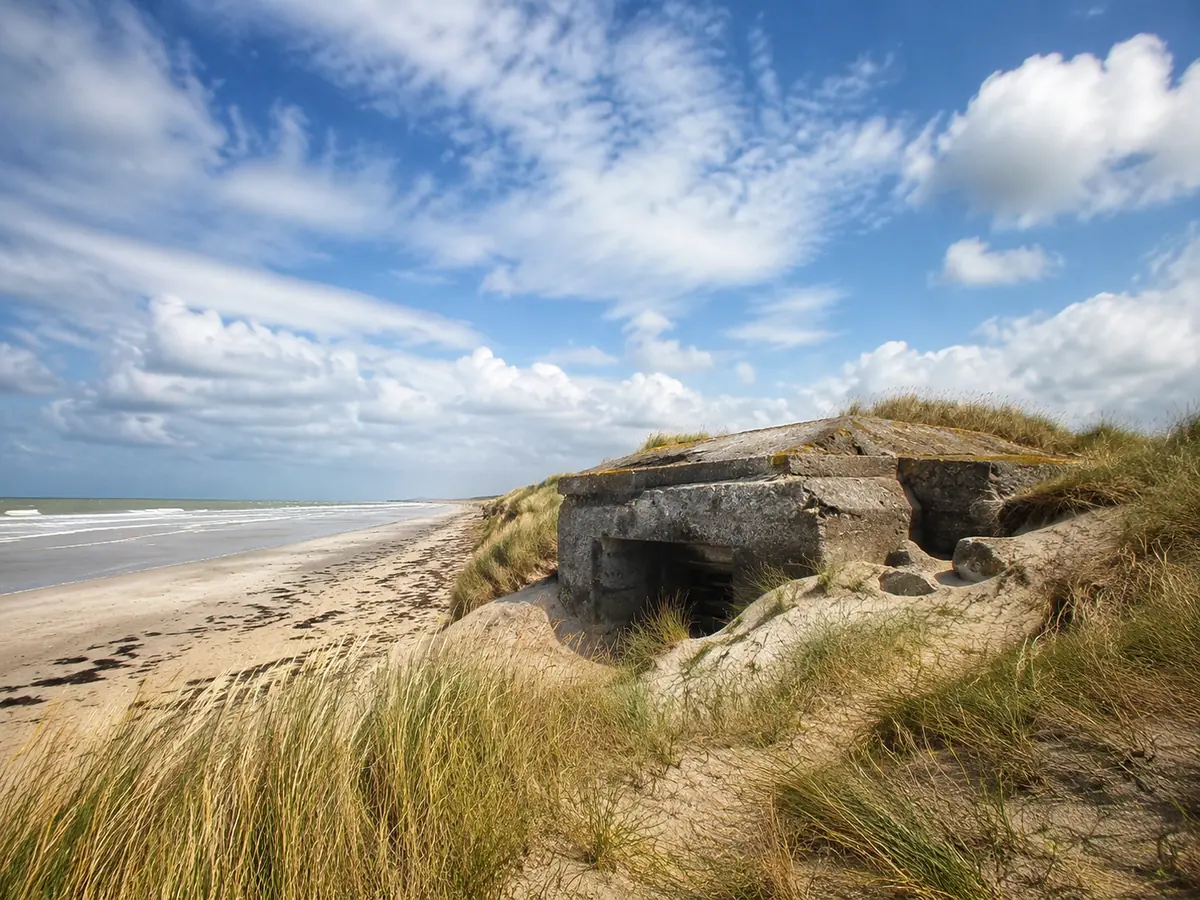
Six miles, 9.7 km, from La Rivière in the west to Saint-Aubin in the east. The 3rd Canadian Infantry Division, the 2nd Canadian Armoured Brigade and Royal Marine commandos put 21,400 men ashore on 6 June. The 3rd Canadian Division counted 340 killed, 574 wounded and 47 taken prisoner — 961 in total — though the Commonwealth War Graves Commission gives a higher figure of over 1,000 casualties with around 370 killed. Sources on D-Day numbers disagree more often than most guides admit; the National WWII Museum says plainly that “many of the numbers … are approximations, and some sources vary widely”. The division also lost 90 of its 306 landing craft to rough seas and a rising tide, which caused severe congestion on the beach.
What is there now: the Juno Beach Centre at Courseulles-sur-Mer, Canada’s museum on this coast, which asks a minimum of an hour and a half and runs a separate 45-minute guided tour of the bunkers underneath. It closes for all of January and on 25 December, and no luggage or backpacks are admitted, which catches out anyone arriving off a train.
Gold — Britain
Nine to ten kilometres between Port-en-Bessin and La Rivière, assaulted by the British 50th (Northumbrian) Infantry Division, the 8th Armoured Brigade and No. 47 Royal Marine Commando. By the end of the day 24,970 men, 2,100 vehicles and 1,000 long tons of supplies had come ashore, for somewhere around 1,000 to 1,100 casualties of whom 350 were killed. Gold pushed roughly six miles inland, the deepest Allied penetration of 6 June.
Gold has the single most extraordinary thing left on this coastline. At Arromanches the Allies built a harbour because they had captured no port: prefabricated in Britain, towed across the Channel and assembled. Mulberry B, “Port Winston”, unloaded up to 18,000 tons of supplies a day. France’s national maritime archaeology service dates its working life from 18 June to 19 November 1944, about five months, against the widely repeated claim that a three-month structure lasted ten. Roughly 96 Phoenix caissons survive offshore, of which only 11 are still in good condition and 67 are ruined, plus 16 concrete floats and three sections of floating roadway. Chloride corrosion is eating them, and the projection is that by 2075 no caisson will remain in good condition. Just along the coast, the Longues-sur-Mer battery is the only battery in Normandy that still has several of its original naval guns in their casemates.
Sword — Britain
About 8 km from Ouistreham to Saint-Aubin-sur-Mer, taken by the British 3rd Infantry Division with the 27th Independent Armoured Brigade, commandos and Hobart’s Funnies. 28,845 men of I Corps were ashore by the end of the day. Casualty figures diverge here more than anywhere: one accounting gives 683, the Commonwealth War Graves Commission approximately 1,300 with around 680 killed, and the two are plainly counting different things. Sword failed to take Caen on 6 June, and the city was not fully occupied until mid-July.
Inland from Sword is where the whole invasion began. British gliderborne troops landed at 00:16 on 6 June at the Caen canal and Orne bridges, the first Allied action of the day. The original 1944 bridge stands in the grounds of the Pegasus Memorial at Bénouville, a few yards from the identical replica now carrying traffic, and the museum holds Major Howard’s red beret, Bill Millin’s bagpipes and a full-size Horsa glider replica. Café Gondrée opposite the bridge was the first house liberated in France and still serves coffee. Ouistreham has the Grand Bunker; Merville Battery is a short drive on. Details and opening seasons for all of these are on the museums and memorials page.
What you can actually book
One tour, and I want to be exact about what it is. It is a small-group minibus capped at eight that visits Juno Beach, the Juno Beach Centre, the Canadian War Cemetery at Bény-sur-Mer, “Hell’s Corner” near Caen, the Abbaye d’Ardenne and German bunkers on site. Entrance fees, food and gratuities are all included. It runs daily, year round, rain or shine, and it is rated 4.9 from 181 reviews, most of them Canadian.
It departs Paris. Café Dada Ternes, 7:00 AM sharp, back around 8:00 PM, thirteen hours door to door. It is not a Bayeux or Caen departure and I will not describe it as one. It also does not visit Arromanches, Gold Beach or Pegasus Bridge — this is a Canadian-sector day, not a British-sector one. The page publishes no accessibility statement, so ask before you book if that matters to you.
Shirley-Anne from Canada described her guide as “supremely knowledgeable with excellent people skills” and ended her review, “Let us NEVER forget what they sacrificed for us”. Timothy Peter called it “a pretty somber, sobering tour of a dark time in world history”, which is about right. Jeannette called it a great way to learn about Canada’s part in the war.
Dedicated British and Canadian sector tours departing Bayeux or Caen do exist on GetYourGuide, and I looked at several. Every one of them had fewer than ten reviews when I checked, which is not enough evidence to put a reader’s day on. I would rather send you to a Paris departure with 181 reviews behind it than to a local one with none, and I will revisit that the moment the numbers change.
If you have a car or two days
The eastern sector rewards self-driving more than the western one does, because the sites are closer together: Pegasus Bridge, Ouistreham, Courseulles-sur-Mer and Arromanches sit within a short run of each other along the coast road. Caen is the practical base for it — bus 101 runs from Caen to Courseulles-sur-Mer for the Juno Beach Centre eight times a day on weekdays and four on Sundays, which is a genuinely usable service by the standards of this coast. With two days, give one to each sector. That is the honest minimum for the whole invasion frontage, and it is what I would tell a friend. The all-tours hub has the American-sector options for the other day.
Can’t make these dates?
Browse more available Normandy D-Day beaches tour and find one that fits your schedule — all with instant confirmation and free cancellation.
Frequently asked questions
Do Normandy D-Day tours visit Juno Beach?
Most do not. The standard itineraries out of Bayeux and Paris cover the American sector — Utah, Omaha, Pointe du Hoc and the American Cemetery — and never cross into the eastern half. One small-group minibus, capped at eight and rated 4.9 from 181 reviews, does go to Juno Beach, the Juno Beach Centre, Bény-sur-Mer and the Abbaye d’Ardenne. It departs Paris at 7:00 AM, not Normandy.
Can I visit Juno Beach and Gold Beach on the same tour?
Not on the tour listed here. The Canadian-sector minibus is focused on Juno and the Canadian sites inland, and does not call at Arromanches, Gold Beach or Pegasus Bridge. To combine them you need a car or a second day. Caen makes the better base for the eastern sector; Bayeux sits closer to the American beaches and to Arromanches.
What is there to see at Juno Beach today?
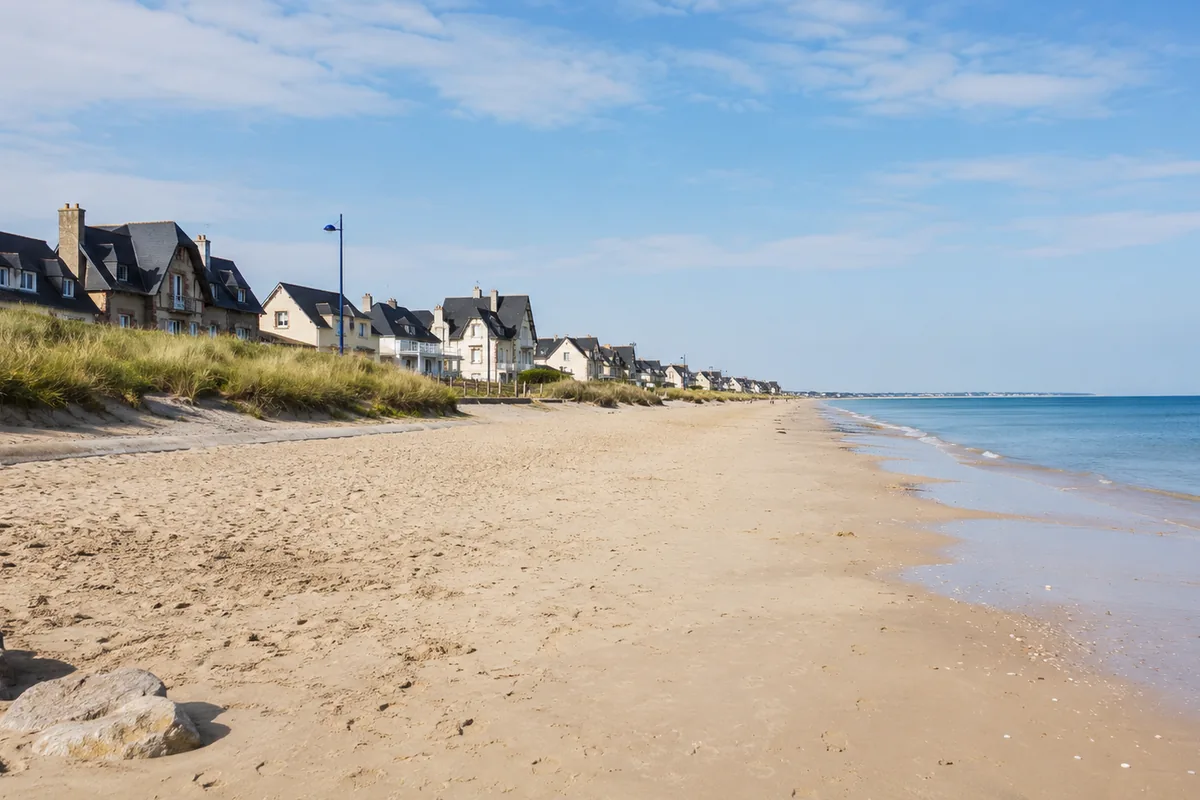
The Juno Beach Centre at Courseulles-sur-Mer is the anchor: Canada’s museum on this coast, a minimum of an hour and a half, with a separate 45-minute guided tour of the bunkers below it. It closes for the whole of January and on 25 December, and does not admit luggage or backpacks. Beyond it are the Bernières and Saint-Aubin seafronts, the bunker complex, and the Canadian War Cemetery at Bény-sur-Mer inland.
Why do most Normandy tours only go to the American beaches?
Demand. The Normandy American Cemetery took over a million visitors in 2024 and the American-sector day sells itself, so that is what operators build. It is not a judgement about which fighting mattered. If the British or Canadian sector is why you are coming, you have to go looking for it deliberately — and if you have no car, look at what public transport actually exists before you assume you can improvise.
What remains of the Mulberry harbour at Arromanches?
About 96 Phoenix caissons survive offshore, of which only 11 are still in good condition and 67 are described as ruined, along with 16 concrete floats and three sections of floating roadway. They are best seen at low tide, from the beach or the high ground east of the town, and they are free to look at. Chloride corrosion is destroying them: the projection is that by 2075 none will remain in good condition.